



Introduction
The subject of rising costs is no stranger to Americans, but increases have been particularly impactful within the housing market. Increases in rent have surpassed changes in earnings by around 12 percent according to the Urban Institute, a quite significant statistic considering that the average American in 2024 spent 32.8% of their income on rent alone. For homeowners, the percentage of income used for mortgage payments was higher at around 38% in 2024 for the typical family. This difference can grow even more substantial for certain population groups, such as the elderly, minorities, or families with children, as well as those considered low-income. In other words, increases in rent have created struggles for renters and homeowners, as more and more people are turning to local nonprofits and government programs for support.
Rising costs are pushing more people toward housing assistance while funding instability threatens the very organizations meant to help.
At the same time, those same programs and nonprofits are facing rapidly proposed funding cuts, threatening their ability to service the most vulnerable residents in a time of dire need. More specifically, federal policy shifts and budgetary constraints occurring within the past year, whether a consequence of proposed cuts by the Trump administration, Pennsylvania state government, or by expiration of federal funding allocated by past administrations, have led to increased uncertainty for non-profit organizations, specifically in the housing sector. Proposed funding cuts are still being discussed in the courts, but their pending legal status prevents dollars from being dispersed. Housing nonprofits have been left wondering about not only the future of their organizations, but also of the well-being of those they serve.
Rising Funding Concerns in the Housing Sector
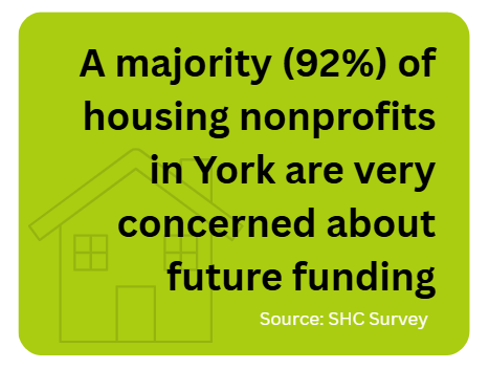
Of individuals receiving assistance, 78% are actively concerned about losing their housing due to funding cuts. 100% of individuals surveyed would lose their housing if all forms of assistance disappeared. When considering housing nonprofits themselves, it was found that a majority (92%) were very concerned about future funding sources. Most of these groups indicated that they presently rely on funding from one or two sources, often nearly 100% on either federal or private funding. These survey results indicate that local housing nonprofits in York, and their beneficiaries, are relying on funding that is increasingly being called into question, at best, and stripped away, at worst.
Additional laws and executive orders do appear to provide some positives, such as expanded PA tax credits for affordable housing under Public Law 119-21, known commonly as the One Big Beautiful Bill (OBBB), as well as the recent Executive Order 14376 that intends to stop firms such as BlackRock from purchasing single-family homes for investment purposes. However, the future of these policies remain in the balance. Concerns about unstable construction costs from continuously wavering tariffs and unsteady international relations endanger the affordability that these tax credits bring. The fact that executive orders change from one administration to the next means that these changes might not persist in the long term, either.
This year’s Homes Within Reach conference, held by the Housing Alliance of Pennsylvania, confirmed that this sense of uncertainty exists not just in York but also across the state. This conference brings together Pennsylvanians with stake in the housing sector, such as housing professionals, local governments, landlords, and builders, providing networking opportunities, educational seminars, and advocacy. Many attendees here stressed budgetary concerns and uncertainty remained a key theme, just as the SHC survey in York suggested. Part of this uncertainty comes from increasing federal scrutiny which has resulted in grant cancellations for projects revolving around diversity-related initiatives. For example, stakeholders at the conference voiced concerns about their ability to serve LGBTQ+ members if grants that included words like “LGBTQ+” were increasingly called into question or downright revoked. No matter the source of uncertainty that these housing stakeholders were experiencing, many attendees shared feelings of grief-like anxiety as they grappled with how to respond to the shifting funding environment.
Looking to the Future
As housing nonprofits look towards the future, the situation feels understandably difficult. Although policy changes are common between administrations, “they often appear over a much slower two-to-three year cycle,” Kelly Blechertas, the Program Coordinator for the York County Coalition on Homelessness, indicated. In other words, the normally slow movement of the Federal Government has previously allowed organizations to plan their operations in conjunction with changing government policy as opposed to in response to it, something many housing nonprofits are dealing with now. “The most disruptive issue is the lack of consistency,” Blechertas shared. “Housing requires long-term planning.” With potential cuts being argued in court and sudden changes regularly being executed, the situation as a whole feels challenging.
Unfortunately, no single solution can fix what housing nonprofits are enduring. It is a complex issue riddled with unpredictability, and providers simply cannot control or anticipate the changes to come. This doesn’t mean, however, that the housing sector is without hope. Just as during times of personal vulnerability, there is the opportunity to heal and work through what we can while still recognizing the losses that have been suffered. Below, two overarching avenues through which housing nonprofits could approach ongoing challenges in funding and organizational stability will be detailed.
Budgeting for Longevity
Inconsistent funding and funding sources were two of the most commonly discussed sources of uncertainty through the SHC survey as well as during the Homes Within Reach Conference. Taking the time to research sister nonprofits, or organizations that focus on similar issues locally, can illuminate new funding opportunities for housing nonprofits. Katie McLaughlin, a grant-writing professional and professor at York College, mentions that researching these sister nonprofits helps identify potential partners or learn about new funders. Particularly in a time of funding challenges, Katie stressed the importance of having a clear answer to why a donor should want to fund you, articulating this as what she calls the “Why you? Why now?” concept. What is it about your nonprofit that makes your mission particularly valuable? What are you doing that others are not? Katie currently offers free grant-writing services through York College’s Center for Community Engagement to help nonprofits answer these questions and cultivate grant applications. This resource may provide housing organizations with grant writing support in addition to that which the York County Coalition on Homelessness currently provides. Outside of in-person grant-writing resources, housing nonprofits interested in identifying new funding opportunities may find documents that compile local philanthropic information, such as the following link, helpful. Finding new funding often takes extended time and energy, something which many nonprofits are already overtaxed on, making these types of connections and resources ever more valuable.
Increasing Efficiency through Uniqueness in Operations
Across Pennsylvania, some housing nonprofits have developed unique organizational structures to support their missions despite funding challenges. Allegheny County Housing Authority (ACHA) is one instance of this. A presenter at the Homes Within Reach Conference, the Executive Director of ACHA Richard Stephenson explained how their partnership with a Pittsburgh-centered workforce development program has been instrumental in increasing operational efficiency and reducing administrative costs. By sharing the screening process of eligible applicants for their own resources through workforce training at other organizations, they have been able to jointly assess the eligibility for long-term housing and secure paid job experience that supports successful housing payments. The team voiced that this strategy, alongside their other operational procedures, had allowed them to avoid some of the uncertainty being faced within the housing sector while also strengthening their community relationships. Stephenson additionally stressed the importance of strong relationships with local educational systems during his session, emphasizing the success in advocacy that they can bring. Involving school systems in the public housing process, he explained, can help reduce the not-in-my-backyard, or NIMBY, attitude infecting many areas across the United States. Bringing school boards and school personnel into the loop with housing projects can help to not only build a sense of community, but also may give a greater sense of support when organizations seek to advocate things like for zoning changes. Since the community and school boards would typically need to provide buy-in for regulation changes to happen regardless, gaining their support early may help bypass long wait periods later down the road.
At a more local level, one housing nonprofit that has persevered for over forty years due to their unique operating model is York Habitat for Humanity. They have similarly stressed the vitality of unique operations and strong community relationships.
To better understand the uniqueness York Habitat’s model brings, it is important to consider that a major difference between York Habitat and many other housing nonprofits is that they don’t focus on rental assistance. “The reason we are uniquely positioned is because we focus on home ownership,” voiced Natasha Kukorlo, the executive director of York Habitat, during a recent interview. Transitioning those they serve into home ownership dissolves dependency on a housing system that relies on federally subsidized rent payments and private landlords. This means that York Habitat’s structure not only has greater capacity to withstand pressure from changing federal legislation but also may present avenues for those it serves to break from the cycle of poverty that current government programs can cultivate. For context, the current system restricts eligibility for rental assistance based on income thresholds as determined by the Department of Housing and Urban Development. As a result, benefit recipients may need to choose between higher paying jobs and the necessities of food and shelter, encouraging dependency on existing systems.
In addition to expanding home ownership, personalizing operations to the area in which a housing nonprofit operates is something that they consider a priority, the executive director of York Habitat Natasha Kukorlo emphasized. “Our 12-18 month program is designed to prepare,” she mentioned during a recent interview, “this includes financial literacy and budget counseling.” Habitat York’s structure also includes what they describe as sweat-equity, a process that directly involves families in the process of building their future home. “It makes sure they are ready for what is to come,” mentioned Kukorlo. She explained that having the opportunity to see how individual components of a home work makes families feel more prepared in the long term, whether that be teaching them how to repair problems or how to save for them.
Being prepared, however, does not mean that families will never need York Habitat support. Isabell Clark, York Habitat’s Volunteer Services manager, emphasized their open door policy. “If families are struggling, they should feel comfortable reaching back out. It makes a difference.” York Habitat tries to maintain these relationships by hosting yearly Habitat family parties. Establishing this connection with community members, including volunteers, is also vital. “Community support is key,” Clark mentioned. “Showing them that their support and effort makes a difference is important.” York Habitat tries to regularly engage local residents whether through opportunities to volunteer, mail correspondence, or invitations to milestones for Habitat families such as ribbon cuttings on new builds.
Considering the operations of the discussed organizations, it is worth considering ways in which other York housing nonprofits could similarly adapt. Are there opportunities to serve a unique population with your organization? Are there any community partners you do not yet work with but could benefit from sharing responsibilities and resources with? Who in the community might want to get involved with your nonprofit? There are many questions to consider.
Although these methods may not work for all housing nonprofits in York, they may present some new approaches to community involvement or operations. Organizations that not only know their communities but are able to adapt to unseen needs and opportunities may find greater stability.
Perseverance in the Face of Adversity
To be clear, there is certainly no capacity to sugar-coat the situation; housing nonprofits exist within an uncertain and delicate balance that has been deeply shaken by recent policy shifts. However, as Blechertas stated during a recent interview, “Our partners have resiliency.” Housing nonprofits in York may be enduring significant struggles, but just as they have endured countless other challenges, this too will be withstood.
***
Special thanks to the housing professionals who offered their time and insights for the cultivation of this article. Your help was invaluable, as is the work you do.

Hannah Zinn is York College of Pennsylvania’s Urban Collaborative Scholar-in-Residence. Her research has primarily focused on urban greenspace and housing, but she is also engaged with the facilitation of local gardening initiatives through her role. Hannah can be connected with on LinkedIn.
References
McKernan, S., Harvey, C., Acs, G., Airi, N., Braga, B., Congdon, W., Tammaro, Jenkins, W. (2025). The American Affordability Tracker. Urban Institute. https://www.urban.org/data-tools/american-affordability-tracker?utm_source=urban_social&utm_medium=linkedin&utm_campaign=american_affordability_tracker&utm_term=pipeline_requests&utm_content=financial_well-being_and_wealth
Exec. Order No. 14376, 91 Fed. Reg. 12 (January 20, 2026). https://www.govinfo.gov/content/pkg/FR-2026-01-20/pdf/FR-2026-01-20.pdf
Hughes, S. A. (2025, June 4). Explainer: Executive orders as a governing tool. https://www.hks.harvard.edu/faculty-research/policy-topics/democracy-governance/explainer-executive-orders-governing-tool
National Association of Home Builders. (2024, May 23). Families Must Spend 38% of Their Income on Mortgage Payments, New NAHB Index Shows. https://www.nahb.org/news-and-economics/press-releases/2024/05/families-must-spend-38-percent-of-their-income-on-mortgage-payments-new-nahb-index-shows
USAFacts. (n.d.). How much do households in the United States spend on rent? USAFacts. Retrieved December 16, 2025, from https://usafacts.org/answers/how-much-do-households-spend-on-rent/country/united-states/