

Despite growing recognition of early childhood education (ECE) as essential to whole-child development and the stability of the broader workforce, recruiting and retaining qualified educators has proven to be a persistent challenge. Surveys indicate that nearly half of early childhood educators in Pennsylvania intend to leave their jobs, with low compensation rates being the top reason for leaving the field, contributing to widespread staffing shortages across the state. This piece examines wage and benefit inadequacies, the problems they create for workforce sustainability, educational quality, and equity, and the actions York County is taking to address them.
Low wages and limited support are driving early childhood educators out of the field, while funding gaps continue to strain the systems meant to sustain them.
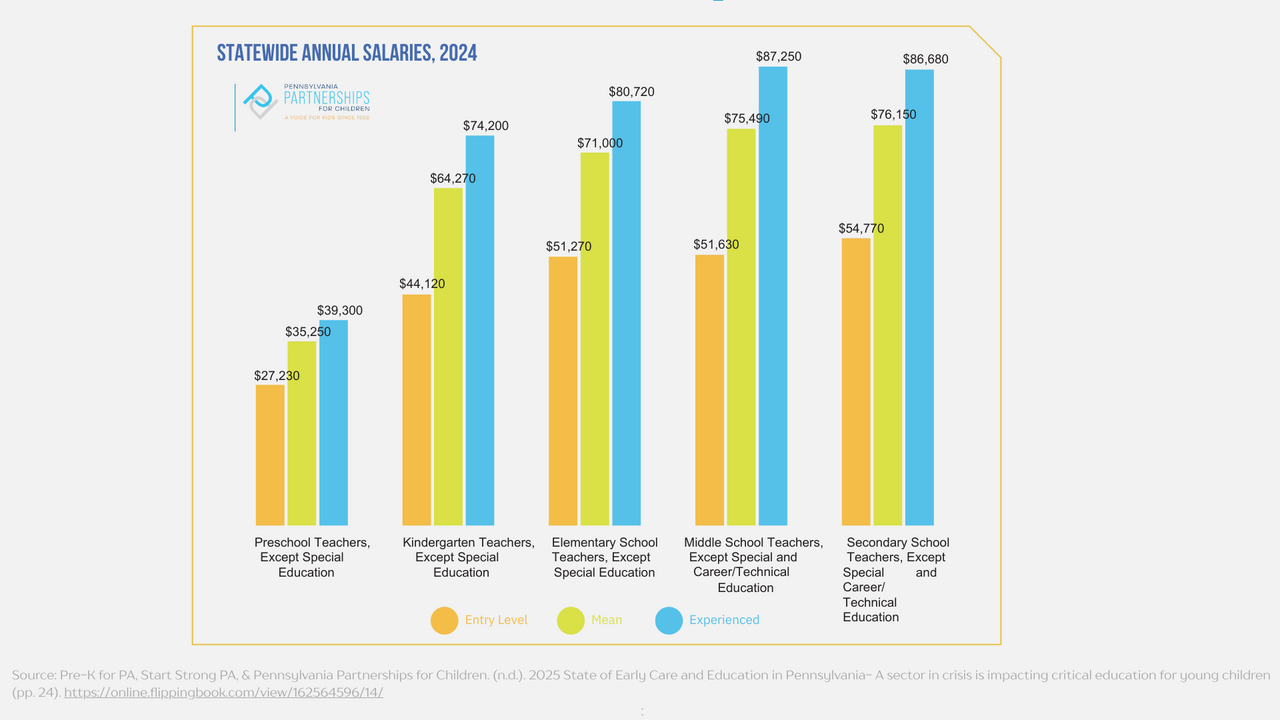
ECE professionals face significant wage gaps, with an average statewide salary of $35,250, compared to $64,270 for kindergarten teachers. Unlike K-12 systems, ECE relies on a limited range of funding sources when budgeting for staff recruitment and retention. The current funding structure creates a persistent gap, as family payments cannot fully cover the cost of high-quality early learning, while federal programs do not meet the full cost required to operate programs and adequately compensate educators. Although facilities may qualify for public funds through programs such as Child Care Works, Pre-K Counts, and Head Start, these supports are insufficient to attract and retain high-quality teachers, as 78% of applicants are unwilling to accept current wage levels. In York, facilities benefit from support provided by local organizations such as the York County Community Foundation and Community Connections for Children, along with initiatives like the ECHO program and the York County Early Childhood Educator Awards Program. However, philanthropic funding is typically time-limited and cannot replace stable, dedicated public funding.
Wage Disparities and Staffing Issues
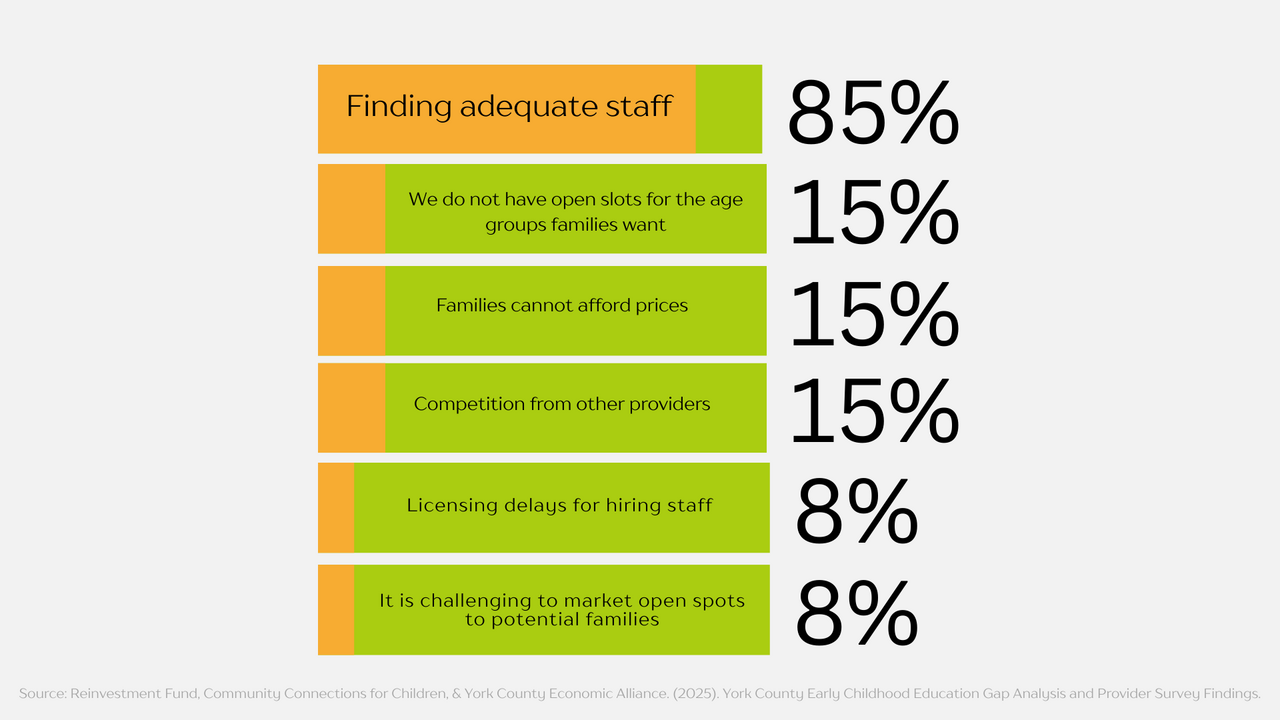
Recent data reported from Pre-K for PA, Start Strong PA, and Pennsylvania Partnerships for Children indicate that the average hourly wage is approximately $15.15 per hour in Pennsylvania. Although salaries differ depending upon employee experience and facilities’ funding status, this average wage falls below the living wage for a singular adult with no children in York County—$22.38. Many ECE providers report that low compensation and limited support are key drivers of poor staff retention. Indeed, in a survey of ECE providers, 85% identified staffing issues as a top-three barrier to enrollment.
Entering the ECE workforce in the Commonwealth of Pennsylvania requires meeting a range of professional and regulatory requirements designed to ensure safe, high-quality care for young children. For many individuals living in poverty, however, the cost of obtaining and maintaining these credentials presents a barrier—particularly when these expenses are not covered by the facility. These requirements include background checks such as an FBI Fingerprint-Based Background Check, Child Abuse History Clearance, and Pennsylvania State Police Criminal History Check, CPR and First Aid certifications, pre-employment health screening, and ongoing renewal requirements, as well as broader educational expectations such as academic qualifications, practicum hours, and continuing education.
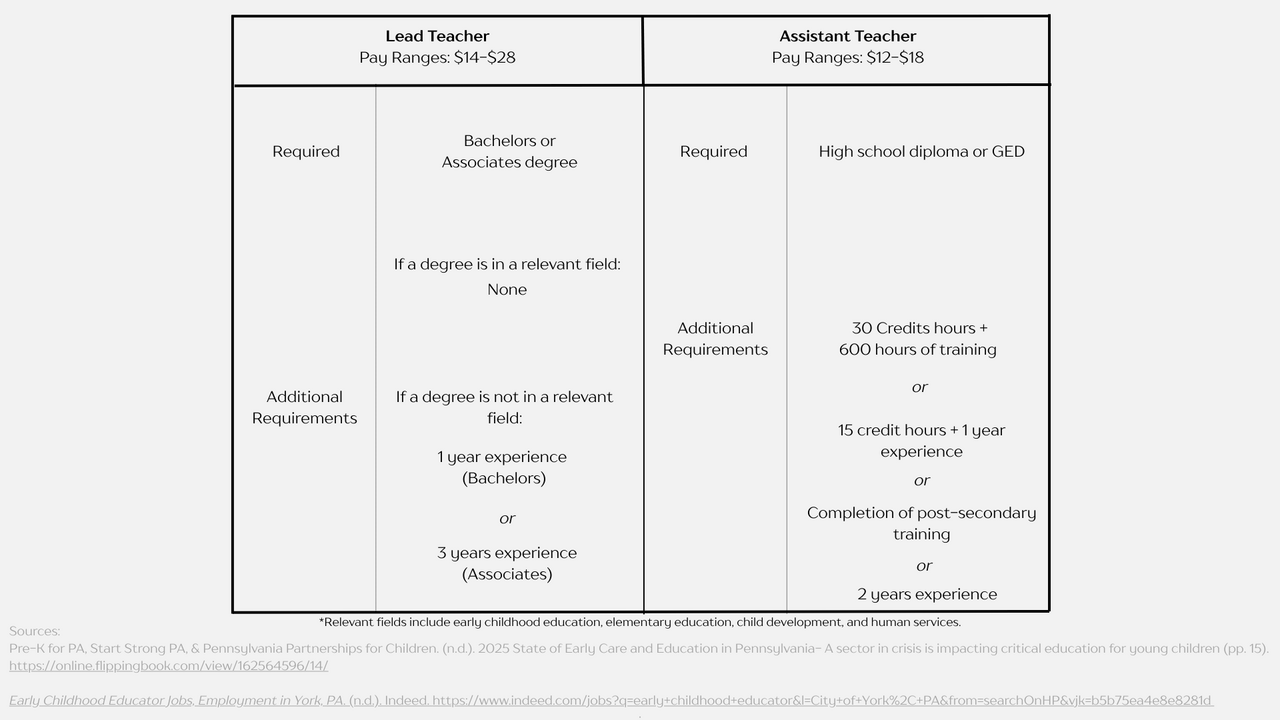
When these requisites are not accompanied by meaningful opportunities for wage growth or career advancement, the return on investment is limited and there is potential to worsen existing economic insecurity for the ECE workforce. For these educators, economic survival may be further threatened by limited access to health insurance, and the inability to afford early learning for their own children. According to Start Strong PA, the average child care teacher lives in poverty at nearly twice the rate of Pennsylvania workers in general.
“these individuals are the workforce behind our workforce.” — United Way of York County
Workforce Stability: ECE Contradictions
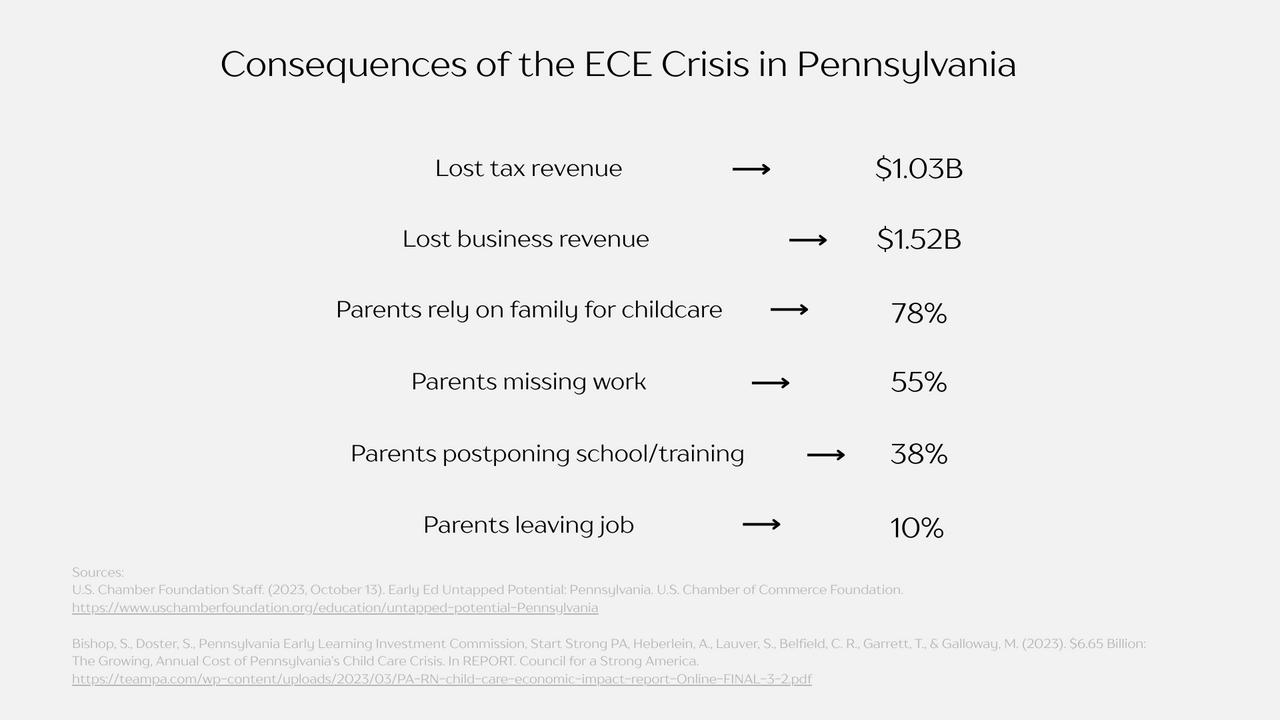
Nationally, the early learning workforce is primarily composed of women. Those employed by early learning providers are also likely to fall within the population of Americans classified as Asset Limited, Income Constrained, Employed (ALICE). According to United Way, ALICE households earn above the federal poverty level but lack sufficient income to meet basic needs such as food, housing, transportation, and early education for their children. Many ECE professionals do not make a living wage and must rely on public assistance programs, secondary employment, or household support. These economic hardships create compounding stressors that interfere with educators’ ability to maintain consistent attendance and engagement in the workplace. Therefore, additional consequences of inadequate compensation include productivity losses related to chronic absenteeism. Together, these issues underscore that workforce instability is not solely a matter of workforce availability, but it is closely tied to compensation and employment conditions. In response, both the state of Pennsylvania and ECE programs have pursued creative and strategic approaches to recruiting and retaining staff.
How PA is Responding to ECE Employment Challenges
Nationally, the early learning workforce is primarily composed of women. Those employed by early learning providers are also likely to fall within the population of Americans classified as Asset Limited, Income Constrained, Employed (ALICE). According to United Way, ALICE households earn above the federal poverty level but lack sufficient income to meet basic needs such as food, housing, transportation, and early education for their children. Many ECE professionals do not make a living wage and must rely on public assistance programs, secondary employment, or household support. These economic hardships create compounding stressors that interfere with educators’ ability to maintain consistent attendance and engagement in the workplace. Therefore, additional consequences of inadequate compensation include productivity losses related to chronic absenteeism. Together, these issues underscore that workforce instability is not solely a matter of workforce availability, but it is closely tied to compensation and employment conditions. In response, both the state of Pennsylvania and ECE programs have pursued creative and strategic approaches to recruiting and retaining staff.
A sign of progress is the release of Pennsylvania’s fiscal year 2025–2026 budget, which many organizations rely upon to strategically plan for the year. A notable investment is the allocation of $25 million to the Child Care Staff Recruitment and Retention (CCSRR) program, which provides approximately $450 per employee as a one-time bonus to support recruitment and retention at licensed CCW provider facilities statewide. While previous efforts, such as the now-defunct Pennsylvania Education and Retention Award program, tied stipends to Keystone STARS ratings and educational attainment, CCSRR offers stipends to all current and qualified staff. Although small, one-time bonuses alone are not enough to lift working families out of poverty, programs like CCSRR represent a larger recognition at the state-level of the need to invest in ECE. This recognition was further strengthened in August 2025 when the Pennsylvania Department of Labor and Industry designated ECE as a High Priority Occupation (HPO) following documentation submitted by CCC, the Early Learning Resource Center for Regions 9 and 10, including York County, and letters of regional support. HPO designation is based on labor market data, employer demand, and input from workforce partners such as PA CareerLink, and brings increased access to workforce funds and underscores the urgency of investing in education, training, and long-term career advancement.
Several other initiatives in the Commonwealth are helping to address pay, benefit, and career pathway gaps. Through the state-run Workforce Innovation and Opportunity Act (WIOA), eligible individuals in diverse workforce sectors can access funding for supportive services, including assistance with required clearances, laptops, or general workforce preparedness. Additionally, CCC’s partnership with Child Development Associate (CDA) Apprenticeship Program and ECHO’s Teacher Aide Program with Harrisburg Area Community College, offer earn-while-you-learn pathways that reduce financial barriers, providing practical experience and industry-recognized credentials. These efforts are complemented by PA CareerLink, which offers free services like individualized, hands-on workforce support directly to ECE employers and employees. By combining employment, education, mentorship, and supportive services, these projects strengthen workforce entry and retention while creating clear pathways for advancement within early childhood education.
Workforce instability in ECE, driven by inadequate wages and benefits across Pennsylvania, reflects the critical role compensation plays in sustaining a stable and qualified workforce. As providers navigate the challenges of staff retention, low wages, and credentialing requirements, the resulting economic pressures place significant stress on programs and, in turn, affect low- and middle-income families. Ultimately, strengthening compensation and career pathways for early childhood educators is not simply about supporting a profession; it is about sustaining the workforce behind the workforce and securing York County’s future.

Anna Howard is York College of Pennsylvania’s Glatfelter Institute for Public Policy Scholar-in-Residence. Her research has primarily focused on social systems and early childhood education. Anna can be connected with on LinkedIn.
References
Bishop, S., Doster, S., Pennsylvania Early Learning Investment Commission, Start Strong PA, Heberlein, A., Lauver, S., Belfield, C. R., Garrett, T., & Galloway, M. (2023). $6.65 Billion: The Growing, Annual Cost of Pennsylvania’s Child Care Crisis. Council for a Strong America. https://teampa.com/wp-content/uploads/2023/03/PA-RN-child-care-economic-impact-report-Online-FINAL-3-2.pdf
Boden, S. for Spotlight PA. (2025, March 25). Private funding has created 100s of new child care spots in this Pa. county. WITF. https://www.witf.org/2025/03/25/private-funding-has-created-100s-of-new-child-care-spots-in-this-pa-county/
Brown, S. & Pennsylvania Office of Child Development and Early Learning. (2025). Child Care Staff Recruitment and Retention Program. https://www.pakeys.org/wp-content/uploads/2025/12/ELRC-Policy-Announcement-25-05-CCSRR-Progam-FINAL.pdf
Caples, K. (2025, July 31). Early Childhood Educator Designated as High Priority Occupation in South Central Pennsylvania: Celebrating a Workforce Win. ECHO – Every Child Has Opportunities. https://echoyork.org/early-childhood-educator-designated-as-high-priority-occupation-in-south-central-pennsylvania-celebrating-a-workforce-win/
Caples, K. (2025, December 16). Community Connections for Children launches Registered Level 1 Child Development Associate Apprenticeship Program. ECHO – Every Child Has Opportunities. https://echoyork.org/community-connections-for-children-launches-registered-level-1-child-development-associate-apprenticeship-program
Careers in Pennsylvania that don’t need a college degree. (2025, December 18). SkillUp Coalition. https://skillup.org/pennsylvania
Center for the Study of Child Care Employment. (2023, February 13). Uncovering the role of early childhood in Black Women’s Clubs work towards racial and gender justice. https://cscce.berkeley.edu/publications/brief/the-role-of-early-childhood-in-black-womens-clubs-work/
Center for Workforce Information & Analysis. (2025). Education. https://www.pa.gov/content/dam/copapwp-pagov/en/dli/documents/cwia/products/pa-industry-clusters/ed-4-pager.pdf
Challenges for Childcare Workers Result in Added Struggles for ALICE Families. (n.d.). United Way of York County. https://www.unitedway-york.org/news/challenges-childcare-workers-result-added-struggles-alice-families
CommissionECE.org. (n.d.). State Actions Advancing the Unifying Framework: A 2025 Review.
https://static1.squarespace.com/static/6407aa4bc56393442ff05b2f/t/6940304dab57ff604b01d45e/1765814350232/2025+State+Review.pdf
Community Connections for Children & York County Economic Alliance. (2025). ECHO York County Teacher Aide Program, 2025-2026. https://echoyork.org/wp-content/uploads/2025/06/2025.2026-York-County-Teacher-Aide-Program-Guidelines.pdf
ECHO – Every Child Has Opportunities 2024 Annual Report: An Early Childhood Education Initiative in York County, Pennsylvania (pp. 1-13). (n.d.). https://heyzine.com/flip-book/fccfca3bd7.html#page/1
Early Childhood Educator Jobs, Employment in York, PA. (n.d.). Indeed. https://www.indeed.com/jobs?q=early+childhood+educator&l=City+of+York%2C+PA&from=searchOnHP&vjk=b5b75ea4e8e8281d
Fix Child Care. (n.d.). Start Strong PA. https://startstrongpa.org/raise-child-care
GCheck. (2025, August 8). Pennsylvania daycare background checks: Complete guide for 2025. https://gcheck.com/blog/pennsylvania-daycare-background-checks/
Governor Shapiro Signs 2025-26 Budget into Law that Cuts Taxes for Working Families, Addresses Critical Workforce Needs, Makes Historic Investments in Education, and Delivers for Pennsylvanians. (2025, November 12). Commonwealth of Pennsylvania. https://www.pa.gov/governor/newsroom/2025-press-releases/gov-shapiro-signs-2025-26-budget-into-law
Key findings – Early Childhood Workforce Index 2024. (n.d.). Center for the Study of Child Care Employment. https://cscce.berkeley.edu/workforce-index-2024/executive-summary/key-findings/
Living Wage Calculator: Living wage calculation for York County, Pennsylvania. (n.d.). MIT. https://livingwage.mit.edu/counties/42133
Pennsylvania Department of Labor & Industry High Priority Occupations. (n.d.). https://www.pa.gov/agencies/dli/resources/statistic-materials/products/high-priority-occupations
Pre-K for PA campaign. (2021). Invest in Quality: A Case for Paying Closer to What High-Quality Pre-K Costs. https://www.prekforpa.org/wp-content/uploads/2021/03/Pre-K-for-PA-Report_FIN.pdf
Pre-K for PA, Start Strong PA, & Pennsylvania Partnerships for Children. (n.d.). 2025 State of Early Care and Education in Pennsylvania. https://online.flippingbook.com/view/162564596/14/
Reinvestment Fund, Community Connections for Children, & York County Economic Alliance. (2025). York County Early Childhood Education Gap Analysis and Provider Survey Findings. https://echoyork.org/wp-content/uploads/2025/11/Final.-ECE-York-County-staffing-Report.-October-2025.pdf
Sandstrom, H., Kuhns, C., Drukker, D., Caven, Weiland, & Bassok. (2024). Turnover Patterns among Early Head Start Teachers and Home Visitors. https://www.urban.org/sites/default/files/2024-01/Turnover%20Patterns%20among%20Early%20Head%20Start%20Teachers%20and%20Home%20Visitors.pdf
Taking Action: Using the Early Childhood Workforce Index. (n.d.). Center for the Study of Child Care Employment. https://cscce.berkeley.edu/workforce-index-2024/policy-toolkit/
The Economic Impacts of Insufficient Child Care & the Cost of Working in Early Childhood Education. (2023, April 10). Team PA Foundation. https://teampa.com/2023/03/the-economic-impacts-of-insufficient-child-care-the-cost-of-working-in-early-childhood-education/
U.S. Chamber Foundation Staff. (2023, October 13). Early Ed Untapped Potential: Pennsylvania. https://www.uschamberfoundation.org/education/untapped-potential-pennsylvania
Workforce Innovation and Opportunity Act (WIOA). (n.d.). https://www.pa.gov/agencies/dli/programs-services/workforce-development-home/workforce-innovation-and-opportunity-act
Wuori, D., & Suskind, D. (2024). The Daycare Myth. Teachers College Press.
York County Early Learning Investment Commission, & Renjilian, C. (2024). 2024 Educator Awards Program. https://yccf.org/wp-content/uploads/2024/11/ELIC-ECE-Educator-Report-2024.pdf